- What we do
- Our impact
- The Policy Centre
Pledge your support
Help us represent the SME voice and join us in shaping the sector.
- Research & insights
- Training & funding
- Tools & resources
- Alliance
- Skills Awards
Skills Insight: Engineering and manufacturing unpacked – Welding Week 2026
Date
09/07/2026
Category
Insights
For Welding Week 2026, our regular data-led feature shines a spotlight on one of the UK’s most crucial trades. The Industrial Strategy 8 is packed with opportunities for trained welders, but what has the job market looked like in recent years?
We compiled data from Lightcast on vacancy levels, advertised skills, and salary expectations, to find out what how UK employers have been recruiting for such a vital role.
Data on welding-related trades since 2021
As our last deep dive into engineering and manufacturing roles showed, vacancies in welding-related trades were at a high in 2023, and have since shown a steep decline. Here’s a look at how the figures break down across the four nations.
Unique postings associated with welding trades (2021-2026)
| Country | Total unique postings 2021-2026 | Job posting decline since 2023 high | Job postings in 2026 - year to date |
| England | 204,141 | -43.9% | 12,957 |
| Scotland | 14,051 | -33.9% | 1,150 |
| Wales | 8,571 | -43.5% | 438 |
| Northern Ireland | 6,719 | -40.9% | 479 |
‘Welding-related trades’ covers a lot of ground – many unique occupations and a variety of specialist techniques within a range of sectors. Future demand for welding in the UK is likely to concentrate in five high-value areas: nuclear new build, submarine and defence manufacturing, offshore wind fabrication, hydrogen/CCS process infrastructure, and factory-based advanced manufacturing.
Our prediction for the welding trades job market
Based on historic vacancy trends, we predict a moderate 6% increase in welding trade vacancy postings in 2026.
There is no single 10-year forecast for welding vacancies, but current evidence suggests the UK will need at least an additional 32% more welders by 2030 – in engineering construction alone.
Retirement and expected growth in a range of sectors gives us an average estimated need of 1,000-3,000 new or replacement welders over the next 10 years – between 3% and 10% of the entire welding workforce in the UK. A separate estimate reported by BBC News[1] suggests there will be a shortfall of 35,000 workers within the welding sector by 2027.
Recruitment and agencies
Our research on job vacancies in welding-related trades shows that employment services companies, or agencies, placed 68% of job vacancies between 2021 and 2025 across the four Home Nations.
| Country | Percentage of postings with employment agencies |
| England | 69% |
| Scotland | 58% |
| Wales | 56% |
| Northern Ireland | 50% |
This data reflects on the difficulty employers are facing in recruiting directly for these specialist occupations, which is why they’re turning to intermediate recruiters to fill the roles. Agency hiring also suggests a good amount of work within the sector is on a temporary basis. These stats come from some of the biggest names in the field – the data we’ve seen comes from jobs available at companies like BAE Systems, Babcock International Group, JCB, and Tata Steel.
Regional demand for welding across the United Kingdom
In England, our data since 2021 shows the highest demand for roles in welding-related trades has come from the West Midlands, East Midlands, and Yorkshire and the Humber. More than half of combined vacancies posted were for these regions.
Birmingham was the city claiming the highest number of job postings in England, followed by Leicester and Sheffield.
Demand in Scotland has been highest in North East Scotland, Glasgow, and the Lothians. Together they accounted for 49% of total vacancy postings. Glasgow had the highest number of job postings for any Scottish city or town.
More than three quarters of vacancies posted in Wales came from North Wales, South Central Wales, and South West Wales. Wrexham had the most postings for vacancies within welding-related trades – nearly double those of the next highest Welsh destination, Bridgend.
Only around a fifth of welding-adjacent vacancies were posted outside of Mid Ulster/Central, Belfast, and the South/South East regions of Northern Ireland. Dungannon posted the most, followed by Belfast and Armagh in terms of cities and towns.
Most requested specialised skills data (January 2021 – December 2025)
Analysing data pulled from across a near five-year period lets us see how demand for different skills has shifted over time, and whether workers are meeting employer needs.
Most requested specialised skills in welding trade vacancy adverts
| Skill | Appears in % of adverts | |
| 1 | Metal Inert Gas (MIG) welding | 17.8% |
| 2 | Welding | 11.8% |
| 3 | Fabrication | 10.4% |
| 4 | Gas tungsten arc welding | 13.3% |
| 5 | Engineering drawings | 8.2% |
Specialised skills with the largest percentage increase in job vacancy postings
| Skill | % increase | |
| 1 | Technical drawing | 4.4% |
| 2 | Blueprinting | 1.7% |
| 3 | Welding equipment | 1.5% |
| 4 | Shielded metal arc welding | 1.2% |
| 5 | Welding | 1.0% |
Specialised skills with the largest percentage decrease in job vacancy postings
| Skill | % decrease | |
| 1 | Metal Inert Gas (MIG) welding | -6.80% |
| 2 | Gas tungsten arc welding | -2.16% |
| 3 | Disinfecting | -0.64% |
| 4 | Drilling | -0.31% |
| 5 | Production engineering | -0.12% |
Although MIG welding has appeared as a specialised skill in almost a fifth of all welding-related trade job ads over the last five years, it’s still interesting to note the steep decline of almost 7% during the same period. It may be the most-requested skill, but we still see how MIG welding has become a less prominent part of job vacancy postings within the trade. Signs are pointing to broader technical expectations, given what’s in the data for fastest-growing skills including technical drawing and blueprinting.
Most requested common (meta) skills data (January 2021 – December 2025)
Common skills don’t tell the whole story about a trained vocation, but the data does tell us how the role is shifting over time.
Most requested common skills in welding trade vacancy adverts
| Skill | Appears in % of adverts | |
| 1 | Detail oriented | 26.8% |
| 2 | Problem solving | 7.4% |
| 3 | Self-motivation | 6.6% |
| 4 | Teamwork | 6.4% |
| 5 | Strong work ethic | 4.8% |
Common skills with the largest percentage increase in job vacancy postings
| Skill | % increase | |
| 1 | Detail oriented | 16.5% |
| 2 | Troubleshooting | 5.5% |
| 3 | Problem solving | 2.6% |
| 4 | Quality control | 1.9% |
| 5 | Team oriented | 1.1% |
Common skills with the largest percentage decrease in job vacancy postings
| Skill | % decrease | |
| 1 | Communication | -8.00% |
| 2 | Self-motivation | -4.83% |
| 3 | Management | -4.23% |
| 4 | Writing | -2.89% |
| 5 | Teamwork | -0.51% |
Since 2021 there’s been a surge in demand for detail-oriented workers in welding-related trades, as evidenced by the increase in mentions on job vacancy postings.
Problem-solving skills had the third largest percentage increase and ranked second on overall requests, showing the value of workers showing initiative in their role as it also becomes broader with the more technical requirements factored in.
Education, experience, and salary in welding-related trades (January 2021 – December 2025)
Welding is a suitable occupation for workers who left formal education after their GCSEs – the most common education level advertised is up to GCSEs or equivalent.
However, employers do prefer candidates to have obtained a welding certificate – the most common certification required from the data we pulled is a 6G welding certification – so the vacancy postings do appear on the whole to specify some further training is needed.
Employers are most commonly looking for candidates with two years’ experience, and offer a five-year average salary (based on the job postings that stated a salary) of £34,281. This average figure is about £10,000 lower than the average across all engineering and manufacturing sector occupations.
Despite this, welding role salaries on offer have increased at around 5% each year, to a 2026 average salary advertised at £38,609.35.
What kind of projects are specialist welding skills most used on?
From the posted vacancies data, we pulled information on the types of projects where each specialist welding skill was most mentioned, so we could illustrate where each particular skill could take a prospective welder as they began their career.
Project types vs welding specialisms (qualitative intensity)
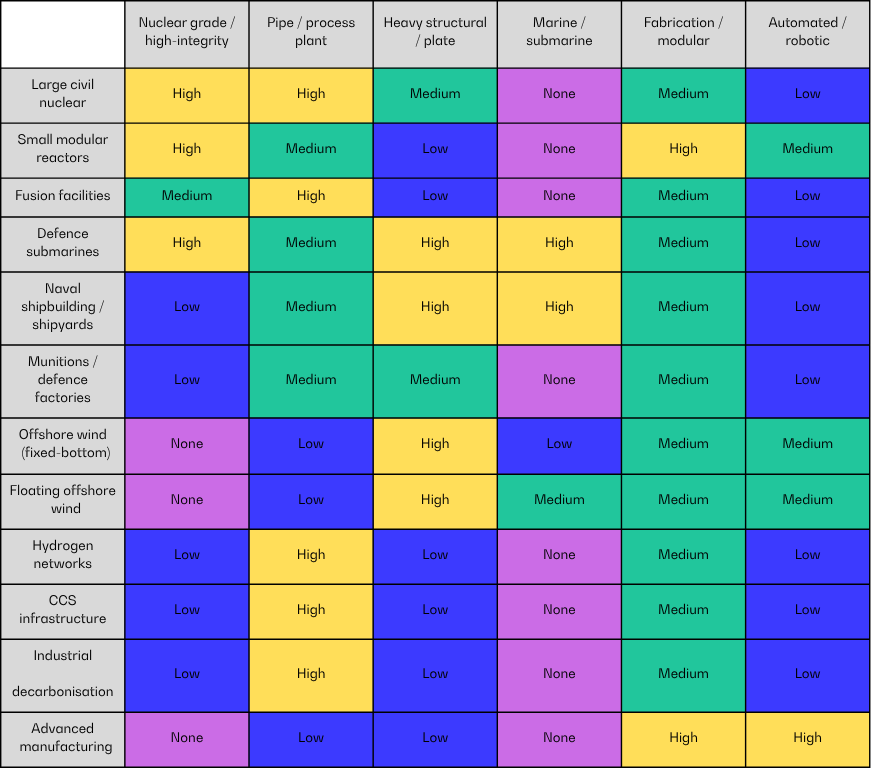
Major nuclear programmes currently under construction, such as Sizewell C and Hinkley Point C, need nuclear-grade welding specialists.
Pipe and process plant welding experts are being recruited for a variety of projects including hydrogen, CCS, and industrial decarbonisation infrastructure.
Heavy structural welding specialists are most commonly drafted in to help make offshore wind a more powerful force. There’s growing demand for modular and automated fabrication here, too.
Advanced manufacturing also needs workers specialising in modular and automated welding, in the sector’s factory-based production systems.
Our take on the welding trades data
Data on recruitment and resource within the welding trades since 2021 shows a transition from a period of intense hiring pressure into a more measured labour market. Postings peaked across the UK nations in 2023 before falling sharply in 2024 and 2025. England (-43.9%) and Wales (43.5%) have seen the steepest decline, with Northern Ireland (-40.9%) and Scotland (-33.9%) also seeing material reductions.
We shouldn’t look at this as a long-term decline in the need for welding skills, however. Based on historic vacancy trends, we predict postings will experience a moderate rise in 2026, to the tune of a 6% increase.
England remains the largest market by volume, but demand is highly concentrated in certain regions. More than half of English job postings are in the West Midlands, East Midlands, and Yorkshire and The Humber. Birmingham, Leicester, and Sheffield are the most-advertised cities for these roles.
The Industrial Strategy 8 launched in 2025 strengthens the case for treating welding as a cross-sector enabling skill, rather than a narrow occupational niche. Several IS8 growth areas — particularly advanced manufacturing, clean energy, and defence — rely on welding capability across shared supply chains. Our data on how specialist skills map against different growth areas illustrates this effectively.
The data on welding-related trades shows us that, despite some recent decline, we’re seeing a mature, regionally concentrated labour market that is becoming more technically demanding. The near-term picture is moderate recovery from the post-2023 fall, while the longer-term opportunity is linked directly to some of the government’s core IS8 priorities – particularly renewables, advanced manufacturing, and defence.
For skills providers, the key is to connect accessible entry routes with stronger capability in the skills which are gaining in importance. Alongside the fundamentals of welding such as pipe and process work, structural fabrication, and plate welding, employers are also calling for skills in technical drawings, solving problems, and focusing on the little details.
Does the data line up with your personal experiences with welding-related trades within the engineering and manufacturing sector?
Keep an eye on our LinkedIn page as we bring you more from Welding Week 2026, celebrating this vital work and the people who perform it.
Follow on LinkedInMore news